
-By Advocate Sandhya Ghimire
For most of its modern history, Nepal’s sporting imagination belonged to football. Dasharath Rangasala was a cathedral, and a packed Saturday match could carry the mood of an entire city. Cricket was the quieter cousin, played on rooftops, in school grounds and on the dusty patches of land that every neighbourhood somehow seemed to find.
Then something shifted.
A generation of players, many from modest backgrounds and far removed from the traditional centres of power, began winning. Associate-level triumphs, historic qualifications, a T20 World Cup appearance and a series of record-breaking performances gave Nepal something it rarely gets: a story the world wanted to hear. Cricket stopped being just a sport and became a statement. It said, “We are here, and we can compete.”
That is a beautiful thing, but also a potentially dangerous one. When a game becomes part of a nation’s identity, it inherits burdens that no sport should have to carry alone. The question facing Nepali cricket is no longer whether it can rise. It is whether it can last.
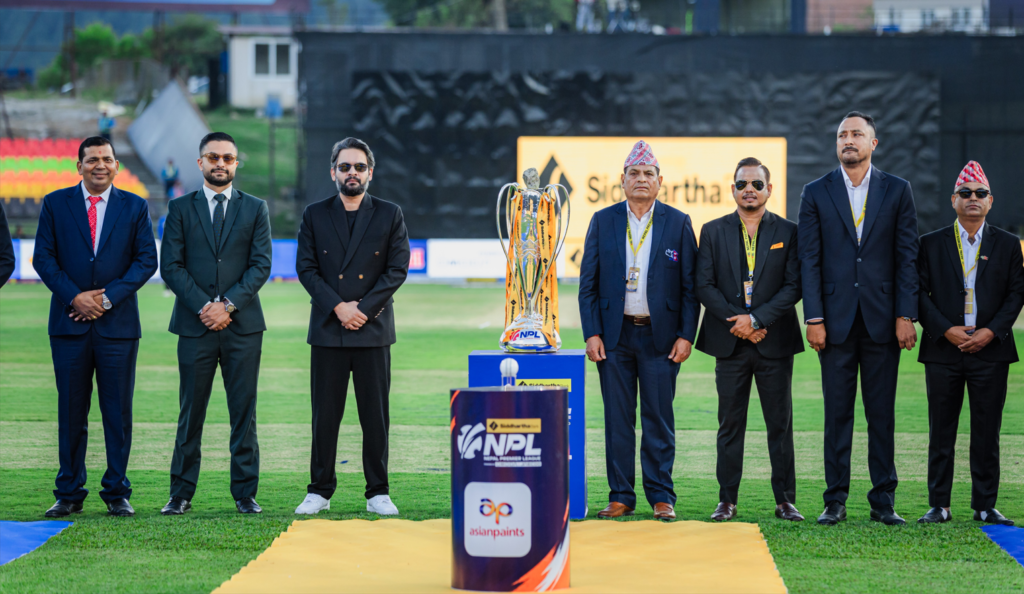
No institution captures this moment better than the Nepal Premier League (NPL). As a franchise-based T20 competition, it has brought floodlights, broadcast production, overseas players, a recognisable brand identity and, most importantly, a major event on the sporting calendar. It has also given domestic cricketers something they have long lacked: a stage, a salary and a reason to dream.
The Nepal Premier League matters for reasons that extend well beyond the boundary rope. First, it professionalises aspiration. A teenager in Janakpur or Pokhara can now imagine a career in which cricket provides a livelihood, rather than remaining a hobby that must be abandoned at twenty-two. It also creates a valuable shop window, allowing Nepali players to share dressing rooms with experienced international cricketers. That is an education no coaching manual can replicate.
Beyond the field, the league helps build a commercial ecosystem in which franchise owners, sponsors, broadcasters and match-day workers all have a stake in the sport’s health. Finally, it gives fans a shared ritual. A league offers people a team to belong to, and that sense of belonging is what turns spectatorship into a sporting culture.
But every league is also a mirror, and the NPL reflects a central tension in Nepali cricket: visibility is growing faster than depth.
A T20 league is the most glamorous layer of a cricketing pyramid. It is the roof. And a roof, however impressive, tells you nothing about the strength of the foundation. In a healthy system, the NPL would be the pinnacle of a structure that pulls the entire game upwards, with club cricket, district leagues, age-group competitions and academies feeding into it, while its success rewards them in return. In an unhealthy system, it becomes a spectacle floating above an undernourished base, delivering excitement while quietly consuming the attention, money and goodwill that grassroots cricket needs even more.
So the real question about the NPL is not, “Is it a good tournament?” It is, “What is it connected to?”
Who Protects the Soul?
If cricket now helps define Nepal’s identity on the global stage, who is responsible for protecting its soul when results fluctuate and expectations rise?
Winning teams are easy to love. The real test comes during a prolonged run of defeats, when sponsors drift away, commentators sharpen their criticism and the public begins to wonder whether earlier success was merely a fluke. A nation’s cricketing soul lies in its patience: its ability to see a young player’s struggles as part of a process rather than as evidence of failure.
That responsibility cannot be outsourced to a single person or institution. It is a shared duty. The governing body must choose long-term planning over crowd-pleasing decisions, the media must resist turning every defeat into a crisis, and fans must understand that a team’s identity should not depend solely on its win-loss record. A sporting culture is preserved by institutions with memory, and Nepal needs to build them.
Fast Growth or Deep Growth?
Is the growth deep and sustainable, or merely fast and emotionally driven? Are we building systems for a decade-long journey, or structures that reward short-term visibility?
The two are easy to confuse because they can look identical from the outside. Packed stadiums, viral innings and rising rankings could be the result of a strong system, or simply the afterglow of one golden generation.
A useful test is to ask what happens when the stars retire. In a deep system, there are already twenty players behind every star, shaped by the same coaching philosophy and competing for the same opportunities. In a shallow one, the next name remains unknown. Nepal has produced remarkable individual talents, but individual brilliance and institutional strength are two very different things.
Short-term incentives can make the problem worse. When selection and recognition favour whoever has scored the most runs in the last three weeks, players learn to protect their numbers rather than develop their overall game. Sustainable development rewards the less visible work: the spinner refining his action over two seasons, or the batter learning to build an innings rather than simply hit through the line.
The Quiet Losses and the Forgotten Coaches
How many talented players are quietly lost each year because of a lack of pathways, patient mentoring and grassroots support? If coaching is the backbone of the game, why are grassroots coaches underfunded, underprotected and often forced to move on?
Every sporting nation loses talent. What distinguishes a mature system is how little talent it allows to slip away. In Nepal, these losses happen far from the cameras: a gifted fast bowler in a hill district with no turf wicket, a left-arm spinner whose family needs him to earn a living, or a promising batter who is never noticed because the selector’s attention rarely travels beyond the valley.
These players do not necessarily fail. They simply disappear from the system, and because they never appear in the statistics, no one counts them. That invisibility is the tragedy.
Part of the solution is a clear, published pathway from school to district, province and national age-group teams, with transparent trials and defined opportunities at every level.
The grassroots coach is the most undervalued figure in this chain. He or she is often the first adult to tell a child that their talent is real, yet is typically paid very little, has no formal career ladder and receives limited support for professional certification. When such coaches leave for better-paying work, as many are forced to do, their knowledge and experience leave with them.
A country serious about cricket must treat coaching as a profession: pay coaches fairly, certify them, protect their interests and create opportunities for career progression.
Infrastructure for Optics or Everyday Work?
Are infrastructure projects being built for tournaments and photographs, or for the thousands of unseen hours of honest, everyday work?
Stadiums are visible, and their inaugurations make headlines. Practice nets, drainage systems, roller maintenance, floodlit training grounds, gym facilities and physiotherapy rooms are less glamorous, but they are what determine whether a cricketer can improve.
The true measure of an infrastructure project is not its inauguration but its utilisation. A ground that hosts four tournaments a year and remains locked for the rest of the time has served the event calendar, not the cricketers.
The best investment of the next decade may be a hundred modest, well-maintained practice venues spread across all seven provinces rather than one more showpiece facility.
Cricket Diplomacy and the Neutral Hub
Can Nepal position itself as a neutral hub for cricket diplomacy, hosting meaningful bilateral and developmental series rather than depending on goodwill alone?
Nepal’s geography is an asset that few sporting nations can claim. It sits between two giants, and its relationships across South Asia have historically been warm. Hosting international cricket, however, is about more than having facilities. It requires consistent scheduling, reliable broadcast arrangements, efficient visa and logistics planning, and a reputation for being easy to work with.
If Nepal can become a regular destination for structured series involving Associate nations, emerging sides and A teams, the benefits could be significant: greater international exposure for its own players, increased tourism, broadcast revenue and stronger diplomatic standing.
But this requires a deliberate strategy and a published multi-year calendar, rather than simply hoping that invitations will arrive.
Women’s Cricket
Is women’s cricket receiving equal planning and opportunity, or only selective visibility when circumstances are convenient?
This may be the most uncomfortable question, and the most important. Women’s teams often receive their greatest attention when a tournament or sponsor demands it, only to be quietly forgotten during the off-season.
Equal planning means equal calendars, domestic competitions, age-group pathways, coaching resources, media coverage and contracts that allow women to treat cricket as a career.
A country that gets this right gains twice over: it expands its talent pool and tells millions of girls that the field belongs to them, too.
Training Winners or Training People?
Are we preparing players to handle pressure, identity and expectations, or merely training them to win matches?
Overnight fame is a heavy burden to carry at twenty. Players from small towns can suddenly become national symbols, facing intense scrutiny, social media noise and financial temptations.
Sport psychology, financial literacy, media training and mentoring on integrity should not be afterthoughts. Cricket, like any other sport, has seen careers derailed not because of a lack of skill, but because of a lack of support.
A system that trains only for batting averages and bowling figures is training only half an athlete.
The Football Question: Why Has the Charm Faded?
It is impossible to discuss Nepal’s cricket boom without addressing the sport it appears to have displaced. Football was once the people’s game, with fiercely loyal supporters, legendary clubs and stadiums that shook with excitement. Why does it now feel diminished?
Football’s fading appeal in Nepal has several overlapping causes.
Results created belief. Cricket gave people victories to celebrate on the international stage, while football, with its low international ranking and fewer memorable results, struggled to provide fans with stories they could celebrate and retell.
Administrative turbulence compounded the problem. Football governance has been marked by disputes, leadership controversies and inconsistent league management. Fans may forgive losing, but they rarely forgive chaos.
The domestic product also remained weak, with changing fixtures, disrupted schedules and none of the consistent branding, broadcast quality and star power that a league like the NPL has deliberately cultivated.
Then came the shift in media and market attention. Once cricket became the dominant story, sponsors and broadcasters followed. This created a cycle in which the sport with more money attracts more attention, which in turn brings in more money.
Beneath all this lies the pathway problem once again. Football suffers from the same lack of structured grassroots development, only more severely, with limited facilities and few visible career routes.
Finally, there is the global-fan effect. Young Nepalis now watch the Premier League and La Liga on their phones. Compared with the polish of those competitions, a poorly organised local match can feel like a downgrade.
The lesson is not that football should be ashamed or that cricket should be blamed. Sports thrive when they are organised well, not simply because they are inherently popular. Football’s declining appeal is largely a story of governance and product quality, which means it can be reversed.
The same applies to volleyball, athletics, martial arts and other sports that produce talent but receive little infrastructure or institutional support. Nepal’s real risk is developing a single-sport culture that treats the success of one game as the nation’s entire sporting policy.
Cricket’s rise offers football a blueprint: credible leadership, a well-marketed domestic league, clear development pathways and consistent international exposure. Cricket, in turn, should treat football’s decline as a warning of what neglect can look like when the spotlight moves elsewhere.
The Verdict of Future Generations
When future generations look back at this era, will they say this was the moment Nepal truly learned how to build cricket, or the moment it almost did?
The answer has not yet been written, and that is perhaps the most hopeful thing about it.
Nepal has talent, passion, a global audience and an emerging commercial ecosystem. What it needs now is less excitement and more architecture: coaches who are valued, pathways that are clearly defined, women who receive equal planning, grounds that are consistently used, players who are supported as people, and a calendar that makes the country a destination rather than a favour.
The NPL can become the engine of that transformation or remain merely its brightest advertisement. The difference will lie in what happens off camera, in the hours nobody films.
Great sporting nations are not built in a single triumphant summer. They are built through thousands of ordinary mornings: a coach setting out cones, a child bowling at a stump, and a committee choosing to fund an unglamorous but essential budget line.
If Nepal commits to those mornings, the historians of tomorrow will not say it almost learned how to build cricket. They will say it began here.
— Advocate, Sandhya Ghimire